

Last updated: March 2026
Podcast SEO (Search Engine Optimization) is what helps your show get discovered. With millions of podcasts out there, great content alone won’t cut it—you need to make sure people can actually find your episodes.
Podcast SEO is the process of optimizing your show and its surrounding content—your website, show notes, titles, and transcripts—to appear higher in search results.
This applies to podcast platforms like Apple and Spotify, as well as Google. By tightening up a few key elements, you can boost your visibility, attract more listeners, and grow your audience.
This guide covers the seven core areas of podcast SEO and walks you through practical steps to help your show rank higher and reach more people starting today.
1. Podcast Keyword Strategy
Before you write a single show note or record an episode, you need to know what words your potential audience is typing into search bars. This is the foundation of any successful podcast SEO plan.
Actionable Tips For Better Podcast SEO
To begin your keyword research, you should first brainstorm seed keywords by starting with the broad topics related to your show; for instance, a personal finance podcast might focus on “budgeting,” “investing,” or “saving money.”
Next, use keyword research tools like the free Google Keyword Planner or paid services such as Ahrefs and SEMrush to discover search volume and ranking difficulty.
When using these tools, always look for long-tail keywords, longer, more specific phrases like “how to start investing with $100”, as these typically have lower competition and are much simpler to rank for.
It is also wise to analyze your competitors by examining the titles and descriptions of the top-ranking shows in your niche to gather new content ideas.
Finally, always focus on listener intent by asking whether people are seeking a quick answer (informational) or a specific product (transactional), and then tailor your episode topics to directly match what your audience is actively searching for.
2. Content Planning: Evergreen vs. Trending Topics
After you’ve identified your core keywords, the next step is to plan your content calendar. Many podcasters simply chase the latest trends, but the most successful shows use a balanced approach to ensure long-term search visibility.
Content Planning Tips
This is where you can gain a significant advantage over your competitors. To stay relevant now and over time, build your content calendar with a quarterly mix of evergreen and trending topics, aim for roughly 70% evergreen and 30% trending.
This keeps your content discoverable year-round while still capturing timely search spikes.
True evergreen topics answer recurring questions in your niche, stay relevant for years, and still make sense to any new listener at any time.
You can keep them performing well by using a simple content-refresh system—periodically updating older strong episodes with new insights or stats, adding fresh commentary, and re-promoting them as “Updated for [Current Year]” to reach both new and returning listeners.
Beyond tools, use audience feedback by running polls or Q&As to uncover foundational topics your listeners want covered, which helps prioritize content planning.
You can also create evergreen series or playlists by bundling related episodes into a “starter series” for newcomers, optimizing the playlist titles for broad search terms to increase session duration and discoverability.
Finally, while trending topics offer quick wins, be sure to avoid the trend-chasing trap by using them only to supplement, not replace, a strong core of evergreen content.
3. Podcast Metadata Optimization
Metadata is the information that describes your podcast to search engines and podcast apps. It includes your show title, episode titles, and descriptions. Optimizing this is crucial for podcast SEO.
Actionable Podcast SEO Tips
Podcast Show Title
Make it clear and include your main keyword if possible. Example: Upgrade “The Money Show” to “The Money Show: Personal Finance and Investing Tips.”
Episode Titles
Your most powerful SEO tool. Treat them like blog headlines and put your keywords at the front.
- Bad: “Episode 42: Our Chat with Sarah”
- Good: “Episode 42: Budgeting Basics: How to Save $500 a Month”
Show Description
Explain what the show is about, who it serves, and the topics you cover. Work your main keywords in naturally.
Episode Descriptions / Show Notes
Write 300+ word summaries with headings, takeaways, and resource links. Aim for clarity and keyword relevance.
4. Podcast Website SEO
While podcast apps are important, Google is still the largest search engine in the world. Having a dedicated website for your podcast is non-negotiable for serious search engine optimization.
On-Page Podcast SEO Tips (Simple and Effective)

Dedicated Episode Pages
Create a unique page for every episode. Include the embedded player, full show notes, and a complete transcript.
Page Titles & URLs
Match your page title to your episode title, and use a clean URL that includes your main keyword. Example: yourpodcast.com/episode/budgeting-basics
Fast, Mobile-Friendly Website
Google prioritizes pages that load quickly and perform well on phones. Use a solid hosting provider and a responsive theme.
Internal Linking
Link older, relevant episodes to your new episode page. This helps Google crawl your site and strengthens topical authority.
Submit Your Sitemap
Submit your sitemap in Google Search Console so every episode page gets indexed quickly and accurately.
Tool Suggestions (Explained Simply)
Google Search Console
Use this to monitor how your site is performing in Google Search. It shows which keywords you’re ranking for, indexing issues, and overall search visibility. It’s completely free.
Yoast SEO (WordPress Plugin)
A solid plugin for tightening up titles, meta descriptions, and on-page keyword optimization. It gives you real-time feedback as you write. There’s a free version and a paid upgrade.
Google PageSpeed Insights
Run your site through this tool to check loading speed and mobile performance. It flags slow elements and gives recommendations to improve your Core Web Vitals. No cost to use.
5. Podcast Transcripts
Transcripts are one of the most powerful, yet often overlooked, tools in your SEO arsenal. They turn your spoken audio into searchable text, which is exactly what search engines need.
Riverside.fm, Descript and Rev Transcripts
Using AI tools like Descript or Riverside, you can generate transcripts with about 90% accuracy and easily clean them up manually for better precision.
If you need near-perfect results without editing, Rev offers a premium paid option.
How to Add Transcripts Without Cluttering Your Page
But don’t just paste the transcript directly onto your episode page—it can clutter the design and hurt user experience. Instead, include the full transcript in a hidden section (like an expandable tab or accordion). Here’s a simple guide to implement this.
If you’re on WordPress, Pat Flynn offers a plugin called Fusebox Transcript Plugin that makes it easy to embed SEO-friendly, collapsible transcripts without any coding.
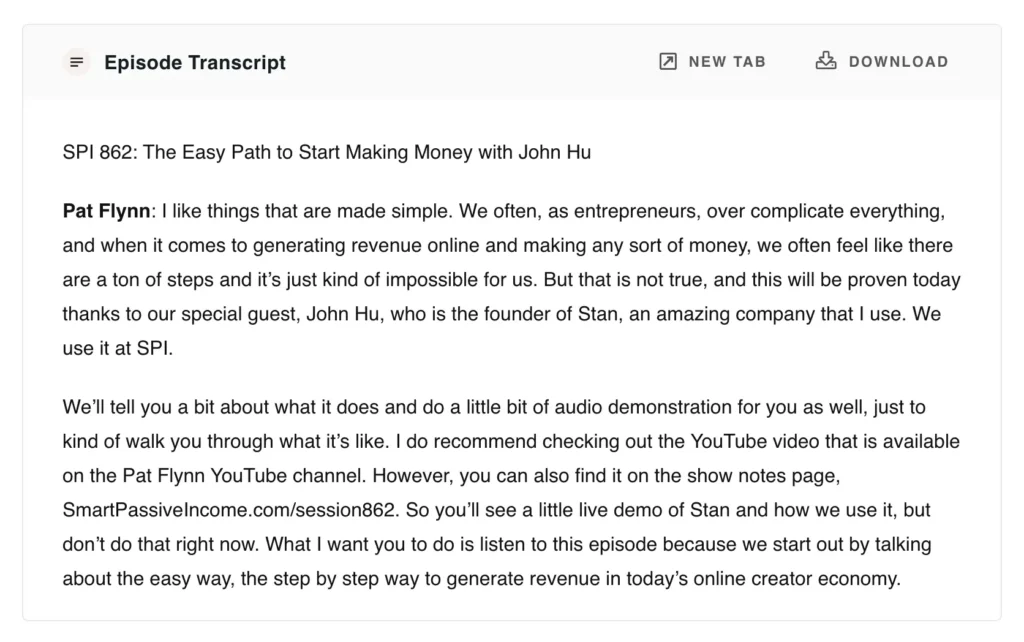
Why Full Transcripts Can Drive Discoverability on Google
If a listener searches Google for a specific quote or piece of advice from your show, a full transcript is the only way Google can find it and direct the listener to your episode page. This is a direct path to new listeners.
6. Backlinks To Your Podcast Webpage
In the world of SEO, a backlink is a link from another website to yours. Search engines view backlinks as “votes of confidence.” The more high-quality votes you have, the more trustworthy and authoritative your website—and your podcast—appears.
Off-Page Podcast SEO Tips (Build Authority & Trust)
Guest on Other Podcasts
Appearing as a guest on other podcasts almost always earns you a backlink in their show notes. These are highly relevant, high-quality links that boost your podcast’s credibility and visibility in search engines.
Create Link-Worthy Content
Publish unique content like original data, in-depth guides, or expert interviews. Valuable resources like these are naturally cited by bloggers, writers, and other creators—earning you organic backlinks over time.
Submit to Podcast Directories
List your show on directories like Podchaser and Listen Notes. Even if some of the links are “no-follow,” they still drive traffic, improve discoverability, and can lead to secondary link opportunities.
Track Your Backlinks
Use tools like Ahrefs or Moz to see who’s linking to your site. You can uncover new link opportunities, fix broken links, and reach out to sites that have mentioned your show without linking.
7. Google SERPs (Search Engine Results Pages)
Google is constantly working to integrate podcasts directly into its search results. When you search for a topic, you often see a carousel of relevant podcast episodes right at the top of the page.
This is a huge opportunity for your show.
Actionable Tips To Rank In The SERP’s
Get indexed by Google. Submit your show so Google can officially recognize and surface your episodes in search.
Take advantage of Google’s audio indexing. Google “listens” to your audio. Clear speech and solid audio quality help it understand and rank your content.
Optimize for featured snippets. Write show notes with clear Q&A sections. Direct, simple questions (“What is the best way to save for retirement?”) can increase your chances of snagging a featured snippet spot.
Use schema markup. Some podcast hosts automatically add schema markup to episode pages. This tells Google what your episode is about. Check if your host supports it.
Example
If someone searches “interview with [guest name]” and you’ve published that interview, Google may surface your episode in the audio carousel—especially if your metadata, transcripts, and show notes are cleaned up and optimized.
8. Podcast Promotion Strategies
SEO isn’t just about technical tweaks; it’s also about getting your content in front of the right people. Strategic promotion amplifies your SEO efforts by driving traffic and earning those valuable backlinks.
Free Actionable Podcast Promotion Tips
- Social media snippets
Share 15–60 second clips from your episodes on TikTok, Instagram, and X. Always link back to the episode page on your site. - Email newsletter pushes
Notify your list when a new episode drops. This early traffic bump helps search engines recognize fresh, valuable content. - Repurpose your content
Use transcripts to quickly create:
– Blog posts
– Quote graphics
– Short video scripts
– LinkedIn articles - Engage with your audience
Reply to comments and messages on your site and socials. Engagement signals relevance to search engines.
Paid Podcast Promotion Marketplaces
- AudienceLift (paid podcast placements)
Run targeted placements that put your show in front of listeners who already follow similar podcasts. Great for growing subscribers fast. - MowPod Boosts
Pay to promote your episodes across content networks. These boosts drive listens and help episodes rank higher in podcast apps. - Overcast Ads
Buy an ad slot inside the Overcast app. Your show appears in the “Recommended” section, which can quickly grow downloads. - Buzzsprout Ads
Use Buzzsprout’s ad marketplace to place short host-read ads for your show inside other podcasts. Strong option for reaching niche listeners.
9. Podcast Visuals and Branding
While SEO is often about text, don’t underestimate the power of visuals in attracting clicks and building a recognizable brand.
Your podcast artwork and overall visual identity are the first things a potential listener sees in a directory, and they play a crucial role in the “click-through rate” (CTR) that search engines value.
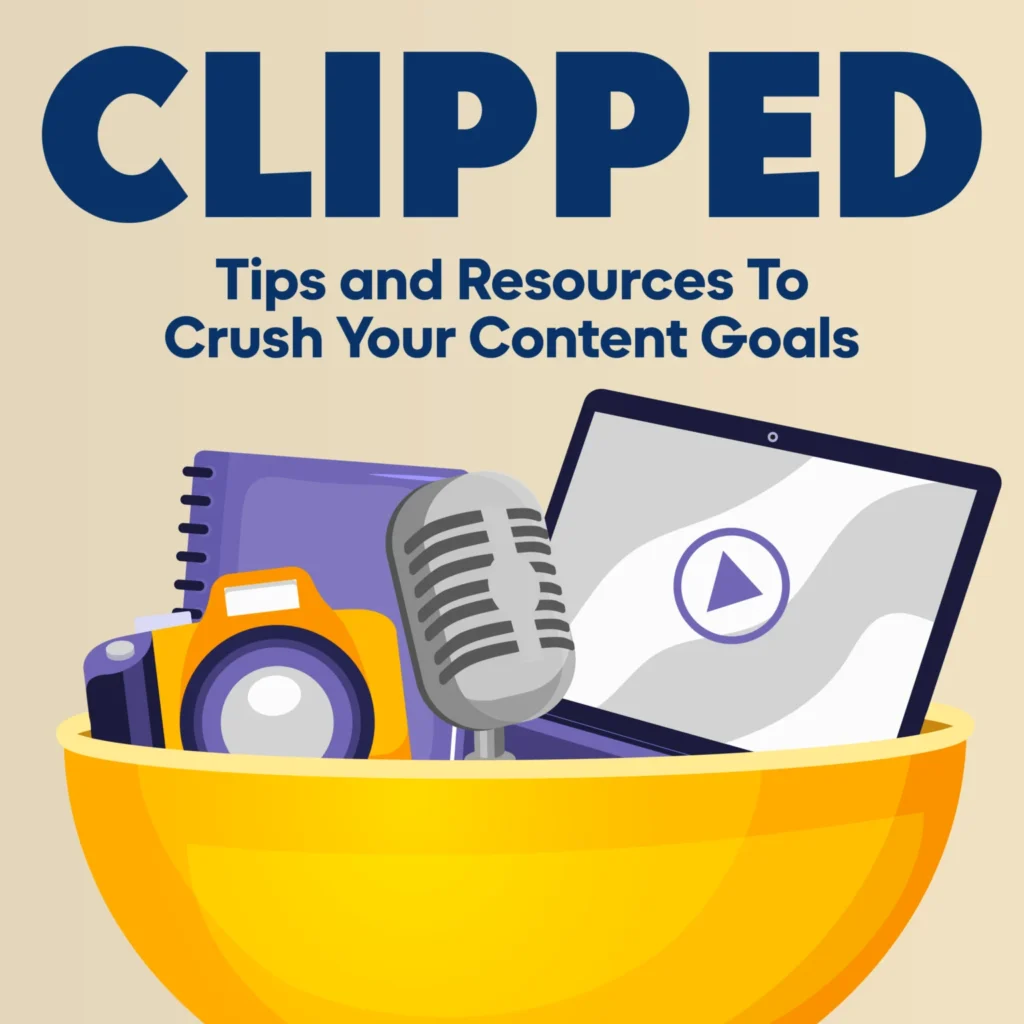
This is the flagship podcast cover art for CLIPPED. The gear mixing in the bowl—camera, mic, notebook, laptop—shows that the show teaches content creation, production, and practical tools for creators.
Podcast Branding Tips
- Dial in your cover art
Use high-resolution (3000 × 3000) artwork that’s clear, readable, and visually strong—even as a tiny thumbnail. - Build a consistent visual style
Stick to a unified set of colors and fonts across your cover art, website, and social banners. Consistency builds recognition and trust. - Optimize images on your site
Compress episode images for fast loading and add descriptive alt text with relevant keywords to support SEO.
Final Thoughts on Podcast SEO
Mastering this strategy is a long-term commitment, not a quick fix. It requires consistency, attention to detail, and a commitment to providing value to your listeners.
By implementing these strategies, from refining your keyword strategy to leveraging transcripts and building quality backlinks, you will not only climb the search rankings but also build a more robust, discoverable, and successful podcast brand.
Start small, be consistent, and watch your audience grow.
Ready to Turn Your Podcast Vision Into Reality?
 Ready To Dominate Your Marketing Niche?
Don’t just create content – create content that converts! Visit The Podcast Haven where we turn your ideas into professional shows that grow your business.
Test Your Podcast Idea’s Market Potential
Got a niche idea that could be podcast gold? Validate your concept and check its market potential with our Podcast Name Checker.
 Get Your Complete launching a podcast Roadmap
Starting a podcast doesn’t have to be overwhelming. I’ve created a comprehensive Podcast Launch Guide that makes launching your show simple and stress-free. Available now on Etsy.
 Need Help Choosing the Right Equipment?
Take the guesswork out of podcast gear selection. Use our free Podcast Equipment Finder to get personalized recommendations based on your recording style, content goals, and budget.
Start Your Podcasting Journey Today
Ready to go from idea to launch quickly and effectively? Sign up for our weekly newsletter and get our free ebook “The Four Pillars of Podcasting” – your complete guide to podcast success.