If you are a video podcaster looking to scale your show, understanding the complex world of ad insertion and monetization is no longer optional, it’s is requirement for survival. As podcasting continues its seismic shift towards video, platforms like Spotify and YouTube have become the new battlegrounds for audience attention.
However, the strategies that work for audio-only podcasts do not simply carry over to video. Many creators assume their existing Dynamic Ad Insertion (DAI) setup will work seamlessly, a misconception that can lead to significant lost revenue and confusion.
This guide will serve as your definitive resource for navigating the entire podcast monetization ecosystem in 2026. We will break down not only how ads function within Spotify’s unique environment but also how professional creators structure their ad strategies across all major platforms.
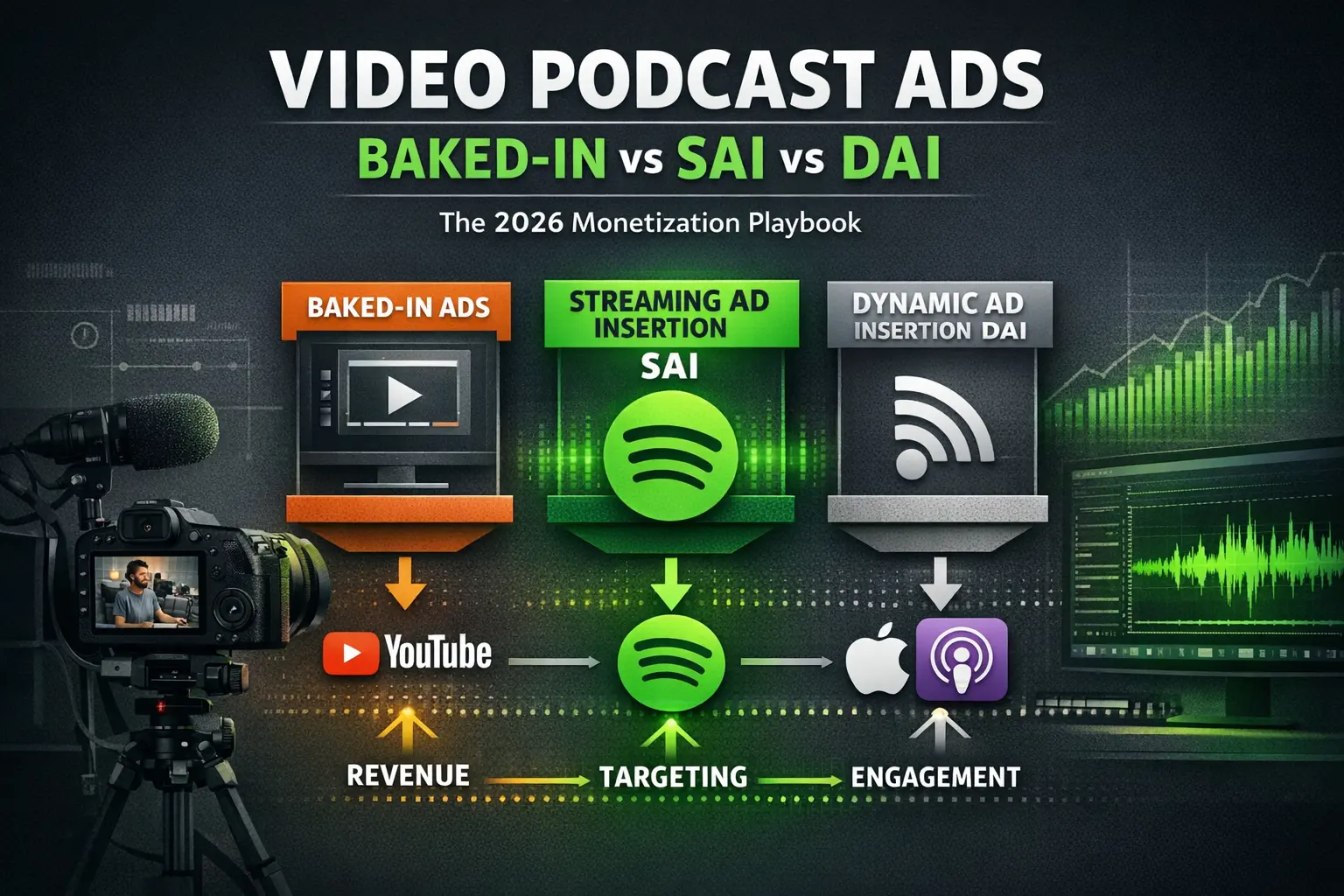
You will gain a complete understanding of baked-in ads, Spotify’s proprietary Streaming Ad Insertion (SAI), the new frontier of Dynamic Video Sponsorships, and how traditional DAI still rules the audio-only world.
By the end, you will have a clear, actionable playbook to maximize your revenue, no matter where your audience consumes your content.
The Three Pillars of Ad Delivery: Baked-In, SAI, and Traditional DAI
To build a successful monetization strategy, you must first master the terminology. There are three fundamental methods of ad delivery in podcasting, and each has a distinct role to play, especially when managing both video and audio formats.
1. Baked-In Ads: The Permanent Solution
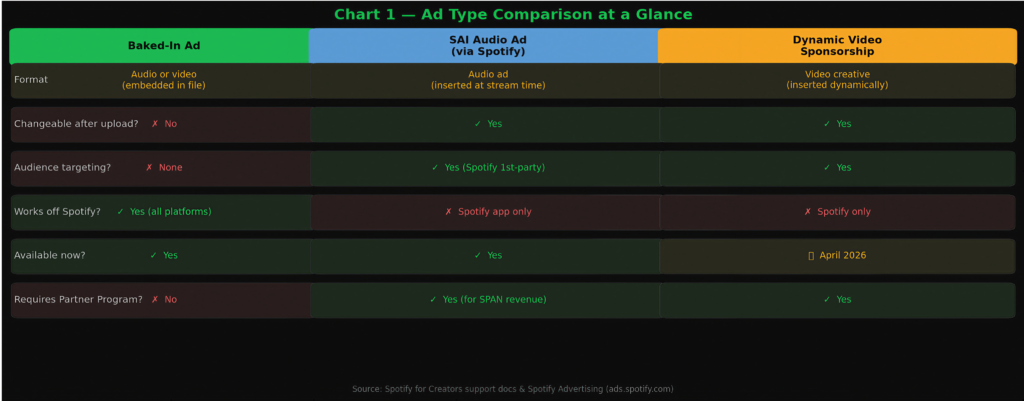
Baked-In Ads are advertisements that are permanently edited directly into your video or audio file before it is uploaded. Think of them as part of the episode’s DNA. Once they are in, they cannot be changed, targeted, or removed.
How Baked In Ads Work:
The ad read, whether by the host or a pre-produced spot, is part of the final media file.
-
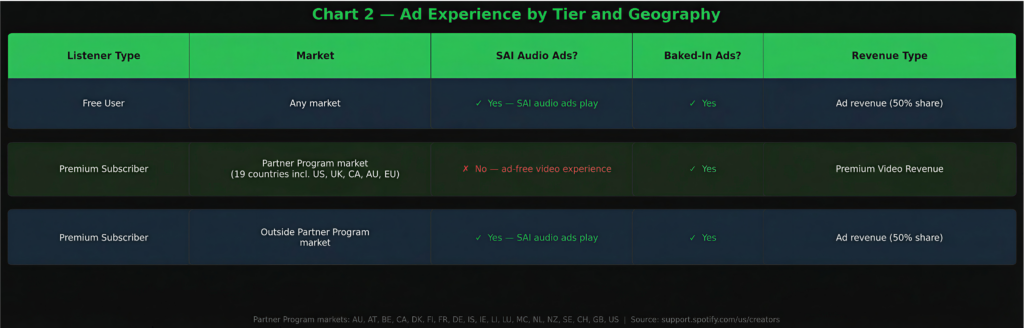
Pros: They play for every single person on every platform (Spotify, YouTube, Apple Podcasts, etc.), guaranteeing 100% reach to your entire audience. They are also the only way to ensure your ad message reaches Spotify Premium subscribers who get an ad-free experience from dynamic insertions.
-
Cons: There is no targeting, no campaign flight dates, and no ability to update ad creative. The ad you bake in today will still be there five years from now, which can be problematic for time-sensitive offers.
2. Streaming Ad Insertion (SAI): The Spotify Standard
This one is weird because it’s new. Streaming Ad Insertion (SAI) is Spotify’s proprietary technology for dynamically inserting audio ads into podcast episodes at the moment a user streams them. This is a critical distinction from the industry-standard DAI.
How Streaming Ad Insertion Works:
Instead of relying on downloads, SAI makes a real-time call to an ad server the instant a listener’s stream hits an ad marker you’ve placed in the episode. This is considered an impression only when the user actively streams past an ad marker in real time inside the Spotify app.
SAI is not an open industry standard; it is exclusive to Spotify’s native player and is only available to shows hosted on Spotify for Creators or Megaphone. When you opt into Spotify’s video and streaming audio system, your traditional RSS-based DAI is replaced by SAI for all Spotify users.
3. Traditional Dynamic Ad Insertion (DAI): The Audio-First Standard
Traditional Dynamic Ad Insertion (DAI) is the industry-standard technology used by the majority of audio-only podcasts distributed via RSS feeds to platforms like Apple Podcasts, Google Podcasts, and others. Unlike Spotify’s SAI, it is download-based.
How Dynamic Ad Insertion Works:
When a creator uploads an audio file to their podcast hosting provider (e.g., Libsyn, Buzzsprout, Megaphone), they place “ad markers” at specific timestamps (pre-roll, mid-roll, post-roll).
When a listener’s device requests to download or stream that episode, the hosting platform’s DAI server “stitches” a targeted audio ad into that slot just before sending the file. The ad served can be based on the listener’s geographic location, the time of day, or other available data.
-
Pros: Allows for incredible flexibility. Ads can be updated across an entire back catalog, targeted to specific regions, and managed in flights with start and end dates. This is the backbone of programmatic podcast advertising.
-
Cons: It is not native to video platforms like YouTube. Furthermore, as of early 2026, its implementation in video podcasts on platforms like Spotify and Apple is being replaced by proprietary, stream-based systems (SAI and HLS-based DAI, respectively).
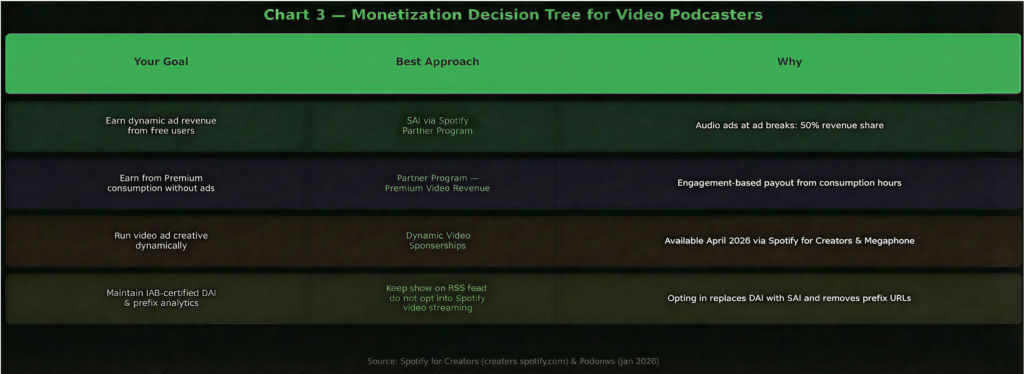
A Hybrid Strategy for Maximum Podcast Revenue
Top-tier creators and podcast networks do not choose one ad method; they use a hybrid approach that leverages the strengths of each platform.
Match The Ad Type To The Platform
Professional creators understand that a listener on Apple Podcasts behaves differently than a viewer on YouTube or Spotify. Therefore, they tailor the ad delivery method to the consumption context.
For Video Platforms (YouTube & Spotify): The Baked-In Approach
When a creator uploads a video episode to YouTube and Spotify, they almost universally use baked-in, host-read video ads. The ad read is a dedicated segment within the video itself.
Why Baked-In Ad Reads For Video Podcasts Is The Best Approach
-
Guaranteed Reach: It is the only way to ensure 100% of the audience sees the ad. It bypasses YouTube’s “Skip Ad” button and, most critically, it plays for Spotify Premium subscribers who are otherwise shielded from dynamically inserted ads.
-
Authenticity and Trust: A host-read ad, where the host integrates the product or service into their content, feels less like a commercial and more like a genuine endorsement. This is the most powerful form of podcast advertising, leading to higher conversion rates.
-
Cross-Platform Consistency: The same video file with the same baked-in ad works perfectly on both YouTube and Spotify, simplifying the workflow. The ad becomes part of the content’s value, not an interruption to it.
For Audio-Only Platforms (Apple Podcasts & RSS): The Traditional DAI Approach
Simultaneously, the audio-only version of that same episode is distributed via an RSS feed to all other podcast players. For this version, the ad agency or creator uses traditional DAI.
Why This Is The Best Strategy:
-
Targeting and Scalability: DAI allows for geo-targeting and demographic targeting, making the ad inventory more valuable. An ad for a local service in Texas doesn’t need to be heard by a listener in London.
-
Monetizing the Back Catalog: A baked-in ad from 2022 is likely irrelevant today. With DAI, a new, relevant ad can be inserted into that same 2022 episode, turning the entire show archive into a revenue-generating asset.
-
Campaign Management: DAI allows for precise control over ad campaigns. An advertiser can buy a flight of one million impressions to run for two weeks. Once the campaign is over, the ad is automatically removed and replaced with a new one. This is impossible with baked-in ads.
Tying It Together: The Ad Copy Workflow
The ad agency sells a campaign to a brand. The core ad copy is developed, and then slightly adapted for each format:
-
Video Version (Baked-In): The host reads the ad copy on camera, often holding the product or showing the website on screen. The call-to-action might be visual (e.g., “Click the link in the description below”).
-
Audio Version (DAI): The host records an audio-only version of the same ad read. The call-to-action is verbal and memorable (e.g., “Go to Brand.com and use code PODCAST”). This pre-recorded audio spot is then delivered to the hosting platform to be dynamically inserted into the RSS feed.
This hybrid model provides the best of all worlds: the high-impact, authentic feel of baked-in ads on video platforms, and the scalable, targeted, and evergreen revenue of DAI on audio platforms.
Deep Dive: Spotify’s Full Monetization Ecosystem
Stay with us. This is where it gets interesting, but perhaps a bit confusing. There’s a lot of moving parts to Spotifys Monetization ecosystem.
While ad revenue is a major component for podcasters, it is not the only way to earn money on Spotify. To create a truly robust strategy, you must understand all the tools at your disposal, which primarily fall under the umbrella of the Spotify Partner Program and other Spotify creator-focused features.
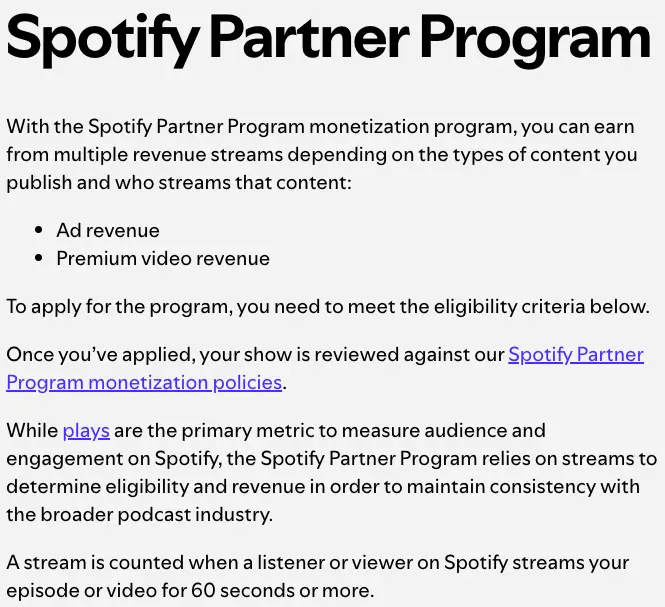
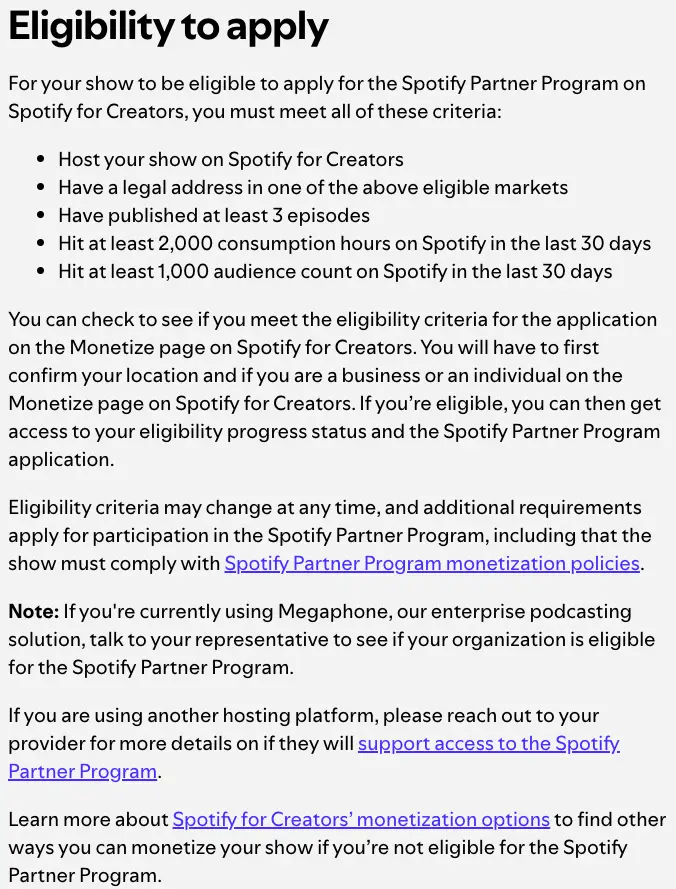
The Spotify Partner Program: Ad & Premium Revenue
The Spotify Partner Program is an invitation-only program for creators who meet certain eligibility criteria. Once accepted, creators can earn revenue in two primary ways from their content.
Spotify Partner Program Ad Revenue:
This is the revenue generated from Spotify’s SAI system inserting audio ads into your episodes for Free users.
-
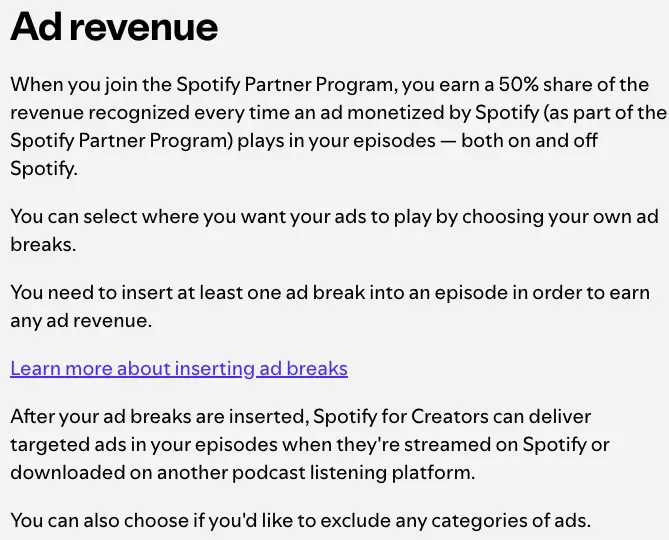
Revenue Split: You earn a 50% share of the net revenue recognized by Spotify for ads played during your episodes.
-
How it Works: You must insert at least one ad break into an episode to be eligible. Spotify’s system then delivers targeted ads from the Spotify Audience Network (SPAN) into those slots for listeners on the Free tier.
Premium Video Revenue:
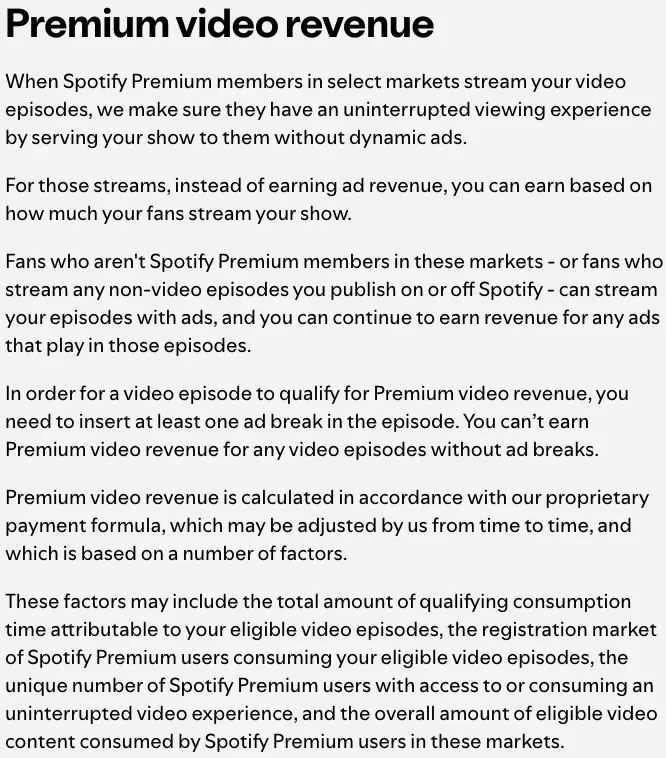
This is how Spotify compensates you for plays from Premium subscribers in the 19 supported markets, who receive an ad-free video experience.
How It Works:
Instead of ad revenue, you earn a share of a pool of money based on engagement. According to Spotify, the calculation is based on a proprietary formula that considers factors like:
-
The total consumption time of your eligible video episodes
-
The number of unique Premium users who watch your videos
-
The registration market of those Premium users
The Black Box:
The exact formula is not public, making it difficult to forecast this revenue stream. However, it is designed to reward creators for producing highly engaging content that keeps Premium subscribers on the platform.
The Future is Dynamic: Video DAI on Spotify and Apple
The playbook described above is the current professional standard, but the ground is already shifting. Both Spotify and Apple are rolling out technology to bring the power of dynamic insertion to video.
-
Spotify’s Dynamic Video Sponsorships (April 2026): This will allow creators to dynamically insert and remove full video ad segments, not just audio ads, after an episode is published. This combines the visual impact of a baked-in ad with the flexibility of DAI.
-
Apple Podcasts’ HLS-based Video DAI (Spring 2026): Apple is overhauling its system to support HLS (HTTP Live Streaming), which will allow for the dynamic insertion of video ads directly within the Apple Podcasts app for the first time. This brings them into direct competition with Spotify and YouTube for video ad dollars.
What this means for you is that the hybrid strategy will become even more powerful.
Soon, you will be able to manage baked-in host reads, dynamically inserted audio ads (for RSS), and dynamically inserted video ads (on Spotify and Apple) from a central dashboard, offering advertisers unprecedented options and maximizing your revenue potential.
Build Your Multi-Platform Monetization Machine NOW
To succeed as a video podcaster in 2026, you cannot afford to think in silos. Your monetization strategy must be as multi-faceted as your distribution.
The professional playbook is clear: embrace a hybrid model. Use high-impact, baked-in video ads for your primary video platforms like YouTube and Spotify to guarantee reach and authenticity.
Simultaneously, leverage the power of traditional, RSS-based DAI to monetize your audio-only audience and your entire back catalog with targeted, scalable campaigns.
Lastly, look beyond ads. Build a community that is willing to support you directly through subscriptions and donations, using the tools Spotify provides.
And keep a close eye on the horizon, as the advent of dynamic video ad insertion on both Spotify and Apple is set to revolutionize the industry once again.
By understanding and implementing this comprehensive, platform-aware strategy, you will not only survive in a competitive market you will thrive.
Struggling To Monetize Your Podcast?
Your audience size isn’t the problem, your monetization strategy is. If you’re tired of waiting to be “big enough,” we’ll help you grow your show so monetization becomes a reality, not a dream.
Schedule a discovery call today. We’ll break down what’s holding your podcast back and exactly how to fix it.
Don’t just create content – create content that converts! Visit The Podcast Haven where we turn your ideas into professional shows that grow your business.
Test Your Podcast Idea’s Market Potential
Got a niche idea that could be podcast gold? Validate your concept and check its market potential with our Podcast Name Checker.
 Get Your Complete Podcast Launch Roadmap
Starting a podcast doesn’t have to be overwhelming. I’ve created a comprehensive Podcast Launch Guide that makes launching your show simple and stress-free. Available now on Etsy.
 Need Help Choosing the Right Equipment?
Take the guesswork out of podcast gear selection. Use our free Podcast Equipment Finder to get personalized recommendations based on your recording style, content goals, and budget.
Start Your Podcasting Journey Today
Ready to go from idea to launch quickly and effectively? Sign up for our weekly newsletter and get our free ebook “The Four Pillars of Podcasting” – your complete guide to podcast success.