
How To Improve Your Podcast SEO in 2026 (5 Actionable Tips)
Welcome to our updated (for 2026) guide on how to improve your podcast SEO. SEO is, Search Engine Optimization, is a term that’s thrown around a lot. Add Podcast SEO to the mix and it can be even more confusing.
The objective of this article is to demystify podcast SEO.
We’ll uncover five actionable tips and techniques that you can apply today to boost your podcast SEO and enhance its discoverability in 2026 and beyond.
What Is Podcast SEO?
Firstly, let’s understand what SEO is. SEO, or Search Engine Optimization, is the process of enhancing the visibility of your content on the internet, making it easier for your target audience to find.
For podcasters, this means optimizing your podcast and its related content to appear in search results on Google, podcast directories like Apple Podcasts search rankings and Spotify, and even on YouTube.
It’s a science, but there’s also a little bit of an art to it.
Key Podcast Statistic:
As of early 2026, there are over 7 million podcasts available worldwide, competing for the attention of over 619 million listeners. A strong SEO strategy is no longer optional; it’s essential for discoverability.
1. Turn Your Podcast Episodes Into Blog Posts
One of the most effective ways to improve your podcast’s SEO is by turning your podcast episodes into detailed blog posts. This strategy allows you to repurpose your audio content while significantly increasing the amount of indexable text on your website.
Start by transcribing your episode and using that podcast transcript as the foundation for a standalone article. Then edit and restructure the content into a clear, readable blog post with headings, summaries, and key takeaways.
This not only improves accessibility for people who prefer to read or rely on transcripts, but it also gives Google a large amount of relevant text to crawl and understand.
The more high-quality written content you publish around your podcast topics, the more opportunities Google has to rank your pages in search results. Over time, these posts can help establish topical authority, increasing your chances of appearing for keywords related to your show.
Well-structured articles also help with emerging AI-driven search. Large language models (LLMs) rely heavily on written web content to understand topics and generate answers.
When your podcast insights exist as clear, informative blog posts that rank in Google and attract links, they are more likely to be discovered, summarized, or referenced by AI systems responding to related questions.

We love pulling our transcripts from Riverside.fm.fm
2. The Art of the Keyword-Driven Title
Titling your episodes is more important than you might think. It’s the first thing potential listeners see, and it’s your first chance to capture attention with something clear and compelling.
To improve your podcast SEO, your episode title should include relevant keywords related to the topic of the conversation. This makes it easier for listeners to discover your podcast when searching inside listening apps like Apple Podcasts or Spotify.
It also helps your episode pages show up in Google when people search for those same topics.
Below are some strong keyword-driven episode title examples from other niches. Each one uses phrases people commonly search for while still sounding natural and clickable.
Business & Entrepreneurship
- How to Start a Small Business in 2026: A Step-by-Step Guide
- Pricing Strategies That Actually Increase Profit for Small Businesses
- How Founders Raise Their First $1 Million in Startup Funding
Health & Fitness
- Strength Training for Beginners: A Simple Weekly Workout Plan
- How to Lose Weight Without Crash Dieting (Science-Backed Tips)
- Zone 2 Cardio Explained: Why Endurance Athletes Swear By It
Personal Finance
- How to Invest Your First $10,000: A Beginner’s Guide
- Index Funds vs. ETFs: Which Investment Strategy Is Better?
- How to Build Passive Income Streams in Your 30s
Parenting
- Toddler Sleep Training: What Actually Works for Parents
- How to Raise Resilient Kids in the Age of Social Media
- Positive Discipline Strategies Every Parent Should Know
These titles clearly signal the topic of the episode and include phrases that people are actively searching for.
The goal isn’t to stuff your titles with keywords, but to naturally include the terms your audience would use when searching for information.
When done correctly, keyword-driven titles improve discoverability in podcast apps, increase the chances of ranking in Google search, and help both listeners and algorithms immediately understand what your episode is about.
3. Conduct Thorough Keyword Research
To find the right keywords for your titles and content, you need to use keyword research tools. Google Trends is a fantastic free tool that shows how often a particular search term is entered relative to the total search volume, helping you spot rising trends.
For more in-depth data, a paid tool like Ahrefs provides detailed information about what content is already ranking for your target keywords and what your competitors are doing.
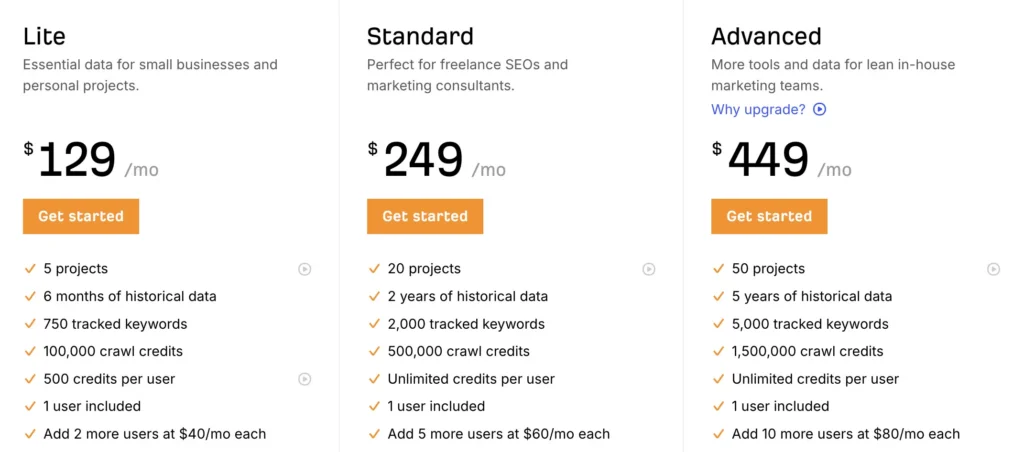
While it’s an investment, Ahrefs now offers a Starter plan at $29/month for basic access, with the full-featured Lite plan at $129/month. The competitive insights can be invaluable for any serious podcaster.
Podcast Specific SEO Tool
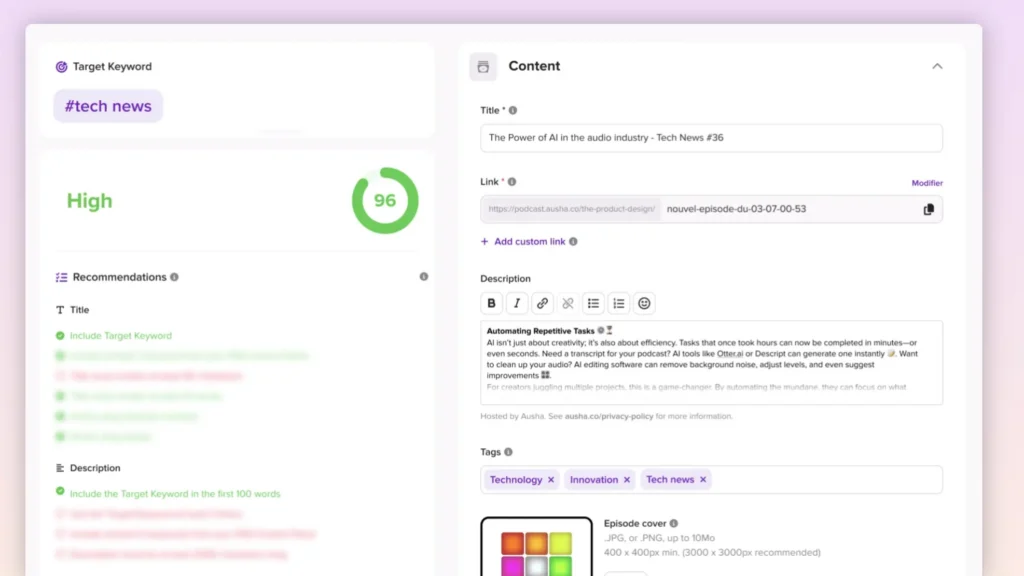
Ausha’s PSO (Podcast Search Optimization) tool helps podcasters improve podcast SEO by optimizing episode titles, descriptions, and keywords so their shows rank higher in podcast apps and search engines.
It’s built for creators and teams who want more discoverability, using data-driven recommendations and real-time scoring to guide improvements before publishing.
4. Create In-Depth Show Notes (Not Just Summaries)
Show notes have evolved far beyond simple summaries. To rank effectively on Google in 2026 — and to appear in AI-generated search overviews — you should aim for comprehensive, blog-post-length show notes.
While the old advice was a 300-word minimum, data now shows that top-ranking pages often feature 1,500-2,500 words of in-depth content.
This gives search engines more data to crawl and to rank, but it also is immensely beneficial for listeners who want to refer back to specific topics, resources, or links you mentioned in the episode.
Think of it as the ultimate resource page for your audio content.
5. Utilize YouTube: The Undisputed SEO Powerhouse
Lastly, do not forget about YouTube. Google owns YouTube if you didn’t know. Thus, it remains the world’s second-largest search engine and is increasingly becoming a primary platform for podcast consumption.
Uploading your podcast to YouTube can significantly improve your podcast’s SEO.
Even if you don’t have a video podcasting, you can still upload the audio with a static image. In the YouTube description, paste your full, detailed show notes, include links, and use relevant keywords in the title, description, and tags.
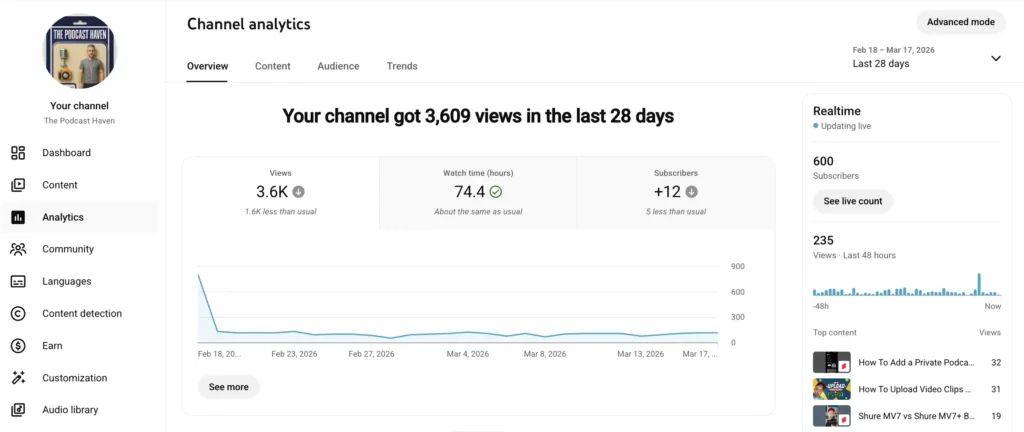
If you need help launching a video podcast on YouTube, we wrote a killer post on starting a video podcast on YouTube step by step.
Key YouTube Stat:
Recent data from Search Engine Land shows that YouTube is cited in up to 29.5% of Google’s AI Overviews, giving it a massive advantage in the new age of generative AI search.
If your podcast isn’t on YouTube, you’re missing out on a critical discovery channel.
Is Podcast SEO Worth It in 2026?
Absolutely. Improving your podcast’s SEO is a long-term strategy that requires patience and consistency. It’s not something that will yield a massive audience overnight, but over time, it can create a durable, compounding engine for audience growth.
By implementing these five techniques, you will build a powerful foundation for your podcast’s discoverability, ensuring your voice is heard by the people who need to hear it most.
Frequently Asked Podcast SEO Questions (FAQ)
Q: How long does it take to see results from podcast SEO?
A: SEO is a marathon, not a sprint. While some quick wins can happen in a few weeks (like ranking for a very specific, long-tail keyword), you should generally expect to see a meaningful impact on your discoverability and listenership within 6 to 12 months of consistent effort.
Q: What’s more important: SEO for Google or for podcast apps like Spotify?
A: Both are crucial, and they feed each other. SEO on Google drives new listeners to your brand and website, where they can convert to subscribers. SEO within podcast apps helps listeners who are already on those platforms find your show when they search for specific topics. A good strategy addresses both.
Q: Do I really need to write 1,500+ words for show notes?
A: To be competitive in Google search, yes. While it sounds like a lot, a good transcription of a 20-30 minute episode can easily provide the bulk of this content. The key is to edit and structure that transcription into a high-value, readable blog post that serves as a comprehensive resource for the listener.
 Test Your Podcast’s Market Potential
Got a niche idea that could be podcast gold? Validate your concept with our Podcast Name Checker.
 Need Help Choosing the Right Equipment?
Use our free Podcast Equipment Finder to get personalized recommendations based on your recording style and budget.
 Start Your Podcasting Journey Today
Sign up for our weekly newsletter and get our free ebook The Four Pillars of Podcasting.
📊 Turn Your Podcast Data Into Growth
See exactly where your podcast can improve. Our FREE AI Podcast Analyzer reviews your content and delivers actionable insights to help you improve podcast SEO and increase discoverability.
📚Want More Podcasting Insights?
Dive into The Podcast Haven Blog Archives